



OTUWA Urges ECOWAS Member States On Adequate Funding, Deliberate Budget for social protection
By Ewache Ajefu
ABUJA — Apex Trade Union Body in West Africa, the Organisation of Trade Unions of West Africa (OTUWA), has called on member Countries to deliberately increase funding, apart from setting aside certain percentage of the national budget to social protection in the sub-region.
The development is sequel to to the International Labour Organization(ILO) global Protection Report 2024-2026 with particular reference to West Africa, where workers, especially in the informal sectors are left to face social protection challenges.
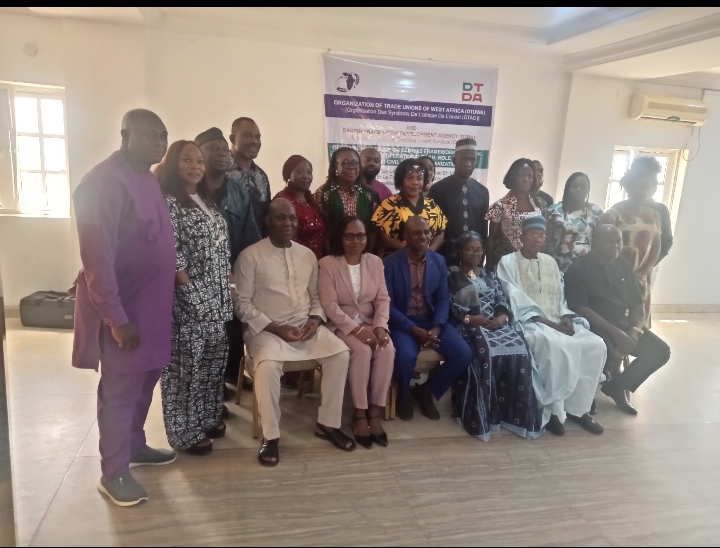
OTUWA made the call in Abuja at 2-day regional workshop on the ECOWAS Framework on Social Protection and its Operational Plan organised in conjunction with the Danish Trade Union Development Agency (DTDA).
The Executive Secretary of OTUWA Comrade John Odah, expressed worry that funding levels in the subregion were quite low.
Citing Nigeria as an example, Comrade Odah said despite its large economy, Nigeria has a social protection coverage rate of 37.6 percentage points below the global average of 52.4 percent, adding that “less than one per cent of our gross domestic product is devoted to social protection. We believe that at least five per cent of our gross national product should be allocated to social protection,”.
He said formal-sector employees often enjoyed maternity protection, health insurance and retirement benefits, while the majority of workers in informal employment had no comparable safeguards.
“What happens to those who are not in formal employment? What happens to the millions of people working in the informal economy who do not have access to these protections?” he asked.
Odah said ECOWAS member States must shift from emergency humanitarian spending and build concrete systems that guarantee health care, old-age pensions and decent shelter for people who cannot afford them.
“Social security should not be treated merely as an additional financial burden on governments. It is a necessary intervention to prevent extreme poverty and protect people from destitution,” he said.
OTUWA’s Acting President, Comrade Sophie Kourouma, posited that the region continued to trail other regions in social protection coverage noting that only 16 per cent of the region’s population enjoyed at least one social protection benefit, compared with the African average of 19.1 per cent.
The 2024–2026 report puts Africa’s effective coverage at 19.1 per cent, up from 15.2 per cent in 2015, but notes that more than 80 per cent of Africans still live without any social protection.
Kourouma described the ECOWAS framework as an important tool for expanding coverage, but warned that its value would depend on how seriously governments implemented it.
“This workshop must produce concrete strategies for engagement, not end with discussions alone,” she said.
National Action plans are expected to be developed by participants from Benin, Ghana, Guinea, Mali, Nigeria, Senegal and Sierra Leone for trade union engagement with the framework.
Speaking at the occasion, Nigeria’s Labour and Employment Minister, Alhaji Muhammad Maigari Dingyadi assured OTUWA of support and cooperation in policy formulation as part of efforts in advancing Social Protection in the county.
The minister who was represented by an Assistant Director in the Ministry, Mr Ifi Aper, acknowledged the enormous contributions of OTUWA and was ready to work with the regional labour body to provide viable social protection initiatives in Nigeria.
Head of DTDA’s Sub-Regional Office in Lomé, Togo, Liliane Napoe, said low public investment and weak coverage constituted a serious challenge for workers, particularly those in the informal economy.
“For trade unions, this framework is both an immense opportunity and an urgent call to action. Regional policies require the robust, early engagement of workers’ legitimate representatives,” Napoe said.
She called for social protection policies that recognise the distinct risks facing women, informal workers, migrant workers and communities whose livelihoods are threatened by climate change.
“Climate shocks directly affect informal livelihoods in agriculture and coastal economies. This makes adaptive social protection systems and a just transition increasingly important,” she said.