



NBS Wants Media Executives to Be Strong Voice, Advocate for Nigeria’s Statistical System
The National Bureau of Statistics (NBS) has called on Media Executives and their respective platforms to become strong voices and advocates for the work of the Bureau and Nigeria’s Statistical System.
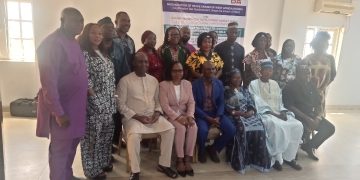
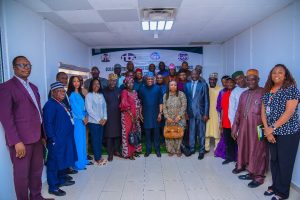
Statistician General of the Federation and Chief Executive Officer, National Bureau of Statistics, Prince Adeyemi Adeniran made the call Thursday in Abuja at the Sensitization of Media Editors and Executives on the Nigerian Living Standards Survey 2022/23 and the Rebasing of Gross Domestic Product and Consumer Prices Index.
“As critical partners in the data production process, we want the media to become a strong voice and advocate of the work you see going on in the Bureau and within the Statistical System in the country”, he said.
“We want your reportage to be accurate, objective, and sound, to help build the confidence and trust of the public in what we do”, the NBS boss further emphasized.
He said the engagement with the Media Executives will expose them to fuller understanding of data production processes, which in turn will reflect in their adequate reportage of the statistics published by the Bureau.
According to him, the development will enhance public understanding and foster trust in the statistical system of Nigeria, most especially the three critical exercises that have been undertaken by the National Bureau of Statistics, the Nigerian Living Standards Survey (NLSS) 2022/23, and the Rebasing of the Gross Domestic Product (GDP) and Consumer Prices Index (CPI).
He noted that the “NLSS provides invaluable insights into household welfare, consumption, and expenditure, enabling us to measure the national poverty headline rate and other essential indicators, while the rebasing of GDP and CPI ensures that our economic data aligns with international best practices and captures the dynamic sectors and activities within our economy.
He emphasized that the NLSS is the survey under which the national poverty headline rate is generated, along with other useful household welfare, consumption, and expenditure indicators, stressing that the year-long survey is conducted every four to five years, with the penultimate round conducted in 2018/2019, and published in 2020, which produced a headline poverty rate of 40.1 percent.
He posited that the methodology for computing the estimates requires enumerators to visit selected households across the country to record their consumption and expenditure, through a 7-day recall process.
According to him, the data collection is done for a year to enable the capture of seasonal variations in household consumption and expenditure. The information collected at the end of the 12 months is then aggregated and appropriately weighted to generate the total national consumption.
He noted that any Households whose total consumption of both food and non-food falls below a certain threshold are then adjudged to be poor and living under the poverty line.
Speaking on CPI rebasing, he said the process entails bringing the weight and price reference periods closer to the current period (Current Consumption Pattern), which is expected to be done every five years.
He said the rebasing of Gross domestic product (GDP) is the process of replacing an old base year with a new/more recent base year which is known as the reference period to keep up with the evolution in prices.
He said all economies undergo structural changes over time (e.g., the growth of the tech sector, and the decline of traditional manufacturing), noting that the rebasing exercise helps to account for these shifts, offering a more accurate snapshot of the economy’s composition.
He said the NBS will continue to remain objective, open, transparent, and professional in it’s work, “as that is the only currency that we have as the national statistical agency for the country”.
“Our door will ever remain open for clarity, input, and any other useful suggestions aimed at adding value to the work that we do”, he said.