

Buhari Wants Financial Sector to Reposition to Take Advantage of AfCFTA
…Commends CBN, NDIC
The federal government has urged the
the financial services industry to reposition itself for the critical roles necessary to enable Nigerians take advantage of the African Continental Free Trade Agreement (AfCFTA).
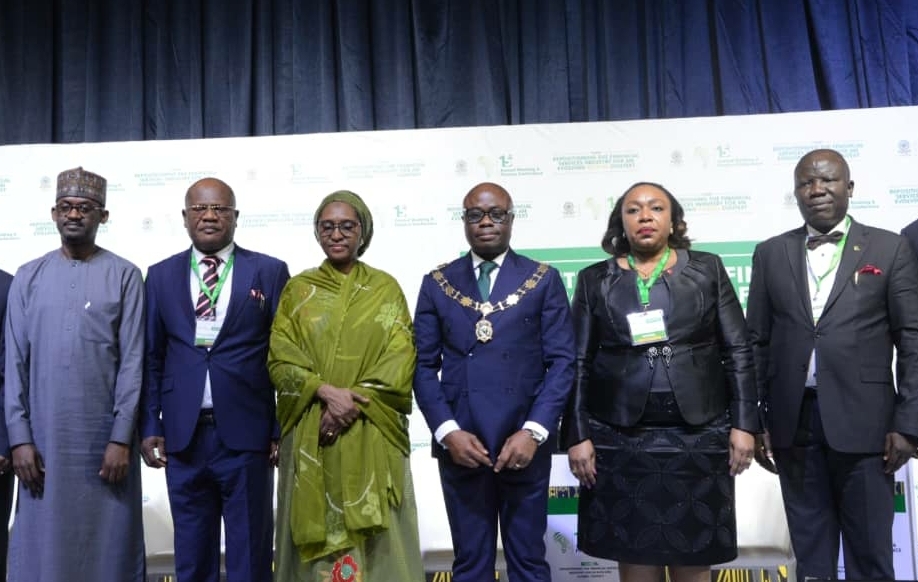
President Muhammadu Buhari stated this in a goodwill message read on his behalf by the Minister of finance, Budget and National Planning, Mrs. Zainab Ahmed, at the opening of the Annual Conference of the Chartered Institute of Bankers of Nigeria (CIBN), in Abuja
The president also commended the Central Bank of Nigeria (CBN) and the Nigeria Deposit Insurance Corporation (NDIC) for the nation’s financial sector stability
The President revealed that the federal government plans to eliminate kerosene lighting in the country by 2030, stressing that the development
was meant to address the global problem of climate change.
“Long-term Greenhouse emissions have resulted in hotter temperatures, more severe rainstorms, increased drought and food security issues”, he said.
He said, “To tackle this issue, the Government has set plans in motion to significantly reduce greenhouse emissions from Nigeria. More specifically, by 2030 we aim to eliminate Kerosene Lighting as well as Short-Lived Pollutants in the Oil & Gas sector.”
President Buhari appealed to all Nigerians to support the administration in tackling terrorism, banditry and other forms of criminality in the country.
“I emphasize that we need a Nigeria of the future that harnesses her strengths, competences, and cultural diversity to tackle the challenges that plague her people, from climate change to pandemics, and insecurity”, he said.
Speaking at the occasion, the Chairman of Union Bank, Mr. Farouk Gumel, urged Nigerian banks to look inwards, in as much as, they might be players on the global scene.
Gumel said: “To reposition for a global context, we also need to look inwards. It is to our peril to lose the local element of what it means to be local.
“This is a country of contrasts. In some respects, Lagos may have as much as London as it does with Langtang in Plateau State. But Nigeria is not a single humongous market. It is made up of many markets. We must adapt ourselves to what works for customers, wherever they are. I will challenge the institute to publish the results of the study that shows the fastest growing retail bank in Kastina and compare that to Calabar; or the most trusted bank in Yola and compare that with Yenagoa.
“After we have seen the data, let us understand why that is so. We have often been reminded of the huge number of Nigerians who still don’t have bank accounts. That is the latest tribe- now called the unbanked tribe.
“The World Bank recently said that there are 64 million unbanked adults in Nigeria. That id 55 percent of the adult population in this country. It is nearly the entire population of the United Kingdom. Imagine a country of that size with no bank accounts. Not even mobile bank accounts. That is what we have in Nigeria today.
“A major concern is the disproportional progress recorded. Research shows that rural population, women at least, are the least impacted by financial inclusion programmes. Those unbanked Nigerians are not only potential savers and borrowers but with our help, these are entrepreneurs and founders of businesses in the future.”
Mr. Gumel urged banks to open rural branches and be closer to the rural dwellers, who form the bulk of the Nigerian population.
In his address, the CIBN President, Dr. Ken Opara said, “As the world continues to evolve, the financial services industry will need to explore innovation and reconfigure its business and operating platforms, in some cases it would require making profound changes to succeed in the future.”