





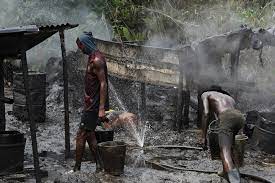
Oil Theft Up to 120,000 Barrels Per Day
Oil theft in Nigeria has increased by about 17% to 120,000 barrels per day (bpd), according to Nigerian Upstream Petroleum Regulatory Commission (NUPRC). Gbenga Komolafe, Chief Executive Officer, NUPRC, made this known at the Lagos Chamber of Commerce and Industry (LCCI) Public-Private – Dialogue on Crude Oil Theft and Artisanal Modular Refineries in Lagos.
However, the Nigerian oil regulator said Federal Government has developed key initiatives aimed at reducing to the barest minimum activities of crude oil theft and illegal artisanal refining.
Komolafe said that an unprecedented level of theft estimated at a daily average of 103,000 barrels which was recorded in 2021 had grown to 120,000 barrels in the first quarter of 2022. He added that daily average production in 2021 stood at 1.5 million barrels while the national production advised by the commission was 2.2 million barrels.
“Consequently, only 58 per cent of the technical rate was achieved in 2021 and similar performance has continued in 2022 hence the need for more concerted efforts across all quarters to stem the tide.
“Unfortunately, the amount of oil received at the terminals indicates that over nine million barrels of oil is lost to crude oil theft amounting to a loss of one billion dollars in the first quarter of 2022,” he said.
Komolafe said that the effect of this level of theft had resulted in the declaration of force majeure, shortage of wealth, a hostile, unsafe environment and was a disincentive to investors in the Nigerian upstream sector.
He added that many operators had deliberately shut down facilities and pipelines which further aggravated the low oil production and also impacted gas production both for domestic utilisation and exports.
He said that in view of the development and the ongoing government’s efforts to enable the industry to deliver a production target of three million barrels daily in three years, the commission has developed some key initiatives.
Komolafe said that the initiatives were aimed at mitigating oil theft and creating enabling regulatory environment for local refining in Nigeria. He said they include: a roadmap for tackling the insecurity challenges in the industry, identifying and implementing areas of collaboration between government and operators in ensuring that operators realise their full production potential.
Others, he said were a massive collaboration with the top civil echelon of the Nigerian security forces for robust security for both operators and host communities.
“The commission is also promoting the implementation of modern security technology for real-time loss detection that would enable swift and more proactive responses.
“We also advocate a refinery regulation in terms of establishment of more modular refineries to curb activities of artesian from refining crude which is outside the ambit of the law and absolutely below acceptable minimum standards of technology in the 21st century,” he said. More at Marketforces


Oil Theft Up to 120,000 Barrels Per Day

Related Posts







Leave a Reply
